
“Capacitors do it backwards”
Series and parallel
Resistors add in series; capacitors add in parallel. Whenever you are unsure, remember they are the opposite of resistors.

Class 12 Physics · Gujarat Board, CBSE, GUJCET, JEE and NEET
Capacitance is where circuit questions begin. Only four ideas are needed: how capacitance is defined, what a dielectric does, how capacitors combine, and how much energy is stored. Series and parallel behave opposite to resistors, and that swap is where marks are lost.
14 formulas, 3 memory hooks, and the 5 mistakes that cost the most marks.
| What | Formula | Symbols and notes |
|---|---|---|
| Definition | C = Q/V | unit farad; one farad is very large |
| Parallel plate capacitor | C = ε₀A/d | A plate area, d separation |
| With a dielectric | C = Kε₀A/d | K is the dielectric constant, always greater than 1 |
| Spherical capacitor, isolated sphere | C = 4πε₀R | capacitance of a sphere of radius R |
| What | Formula | Symbols and notes |
|---|---|---|
| In series | 1/C = 1/C₁ + 1/C₂ + … | charge is the same on each, total C is smaller than the smallest |
| In parallel | C = C₁ + C₂ + … | voltage is the same across each, capacitances add |
| Two capacitors in series | C = C₁C₂/(C₁ + C₂) | the product over sum shortcut |
| What | Formula | Symbols and notes |
|---|---|---|
| Energy stored | U = ½CV² = ½QV = Q²/2C | three forms of one result |
| Energy density | u = ½ε₀E² | energy per unit volume of the field |
| Loss on connecting two capacitors | ΔU = C₁C₂(V₁ − V₂)²/2(C₁ + C₂) | energy is always lost, as heat and radiation |
| Common potential | V = (C₁V₁ + C₂V₂)/(C₁ + C₂) | after the two are joined |
| What | Formula | Symbols and notes |
|---|---|---|
| Battery still connected | V constant, C rises, Q rises, U rises | the battery supplies the extra charge |
| Battery disconnected | Q constant, C rises, V falls, U falls | the field pulls the slab in |
| Field inside the dielectric | E = E₀/K | the induced charges oppose the original field |
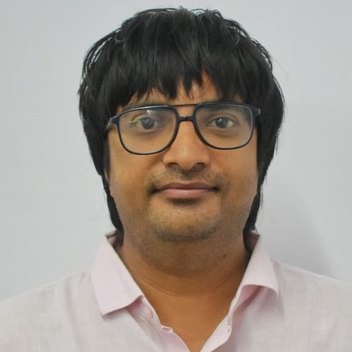
Taught by Darshit Bhatt, founder and lead faculty at Darshit Sir Institute. Instrumentation and Control engineer, with a master's degree and a chartered degree, teaching in Paldi, Ahmedabad since 2006.
Memory hooks
“Capacitors do it backwards”
Series and parallel
Resistors add in series; capacitors add in parallel. Whenever you are unsure, remember they are the opposite of resistors.
“Connected or cut, ask first”
Dielectric questions
With the battery still connected the voltage is fixed. With it disconnected the charge is fixed. Decide which is constant before writing anything else.
“Half CV squared”
Energy stored
U = ½CV². The half is there because the capacitor charges up gradually, so the average voltage is half the final one.
Where marks go
Test yourself
Ask DSI
Tell us the chapter and your class. We will tell you honestly whether our batch helps.
Related
Bring the student's last two report cards. You will get an honest read on where they stand and which batch actually helps, from the person who will do the teaching.
Get in touch
Four different ways, whichever suits you.
Enquiry
Four required fields, the rest optional. We will open WhatsApp with your details written out, ready for you to send.
Almost there
Your browser blocked the automatic hand-off, which is normal inside the Instagram and Facebook apps. Your enquiry is written and ready. Tap below to open WhatsApp and send it.
Open WhatsApp and sendIf it still will not open, save this number and message it directly: +91 98981 73421
Can we count your visit?
We use Google Analytics and Microsoft Clarity to see which pages help and which ones confuse. They set cookies. We do not run adverts and we never share this with anyone. Everything on the site works the same if you say no.