“ELI the ICE man”
Who leads, voltage or current
In an inductor (L), E leads I: ELI. In a capacitor (C), I leads E: ICE. One phrase settles every phase question in the chapter.
Class 12 Physics · Gujarat Board, CBSE, GUJCET, JEE and NEET
AC takes the DC circuit you already know and adds phase. Reactance replaces resistance for capacitors and inductors, impedance ties them together, and resonance is the one result asked every single year.
15 formulas, 3 memory hooks, and the 5 mistakes that cost the most marks.
| What | Formula | Symbols and notes |
|---|---|---|
| RMS current | Irms = I₀/√2 = 0.707I₀ | what an AC ammeter reads |
| RMS voltage | Vrms = V₀/√2 | 230 V mains means a peak of about 325 V |
| Average over a full cycle | zero | which is why RMS values are used at all |
| Angular frequency | ω = 2πf | f is 50 Hz in India |
| What | Formula | Symbols and notes |
|---|---|---|
| Inductive reactance | XL = ωL = 2πfL | rises with frequency; an inductor blocks high frequency |
| Capacitive reactance | XC = 1/ωC = 1/2πfC | falls with frequency; a capacitor blocks DC |
| Impedance of a series LCR | Z = √(R² + (XL − XC)²) | the AC version of resistance |
| Phase angle | tanφ = (XL − XC)/R | current lags when inductive, leads when capacitive |
| Current | Irms = Vrms/Z | Ohm's law with impedance in place of resistance |
| What | Formula | Symbols and notes |
|---|---|---|
| Average power | P = VrmsIrms cosφ | cosφ is the power factor |
| Power factor | cosφ = R/Z | one for a pure resistor, zero for a pure inductor or capacitor |
| Wattless current | P = 0 when φ = 90° | a pure inductor or capacitor consumes no average power |
| Resonant frequency | f₀ = 1/2π√(LC) | at resonance XL = XC |
| At resonance | Z = R, current is maximum, φ = 0 | the circuit behaves as a pure resistor |
| Quality factor | Q = (1/R)√(L/C) | sharper resonance means a higher Q |
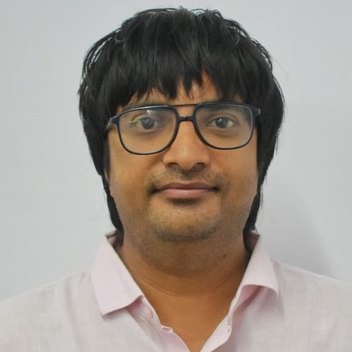
Taught by Darshit Bhatt, founder and lead faculty at Darshit Sir Institute. Instrumentation and Control engineer, with a master's degree and a chartered degree, teaching in Paldi, Ahmedabad since 2006.
Memory hooks
“ELI the ICE man”
Who leads, voltage or current
In an inductor (L), E leads I: ELI. In a capacitor (C), I leads E: ICE. One phrase settles every phase question in the chapter.
“Inductors hate fast, capacitors hate slow”
How reactance changes with frequency
XL rises with frequency and XC falls. That is why a capacitor blocks DC completely and an inductor passes it freely.
“Resonance is a tie”
What happens at f₀
The two reactances cancel exactly, impedance drops to R, and the current peaks. It is how a radio picks one station out of many.
Where marks go
Test yourself
Ask DSI
Tell us the chapter and your class. We will tell you honestly whether our batch helps.
Related
Bring the student's last two report cards. You will get an honest read on where they stand and which batch actually helps, from the person who will do the teaching.
Get in touch
Four different ways, whichever suits you.
Enquiry
Four required fields, the rest optional. We will open WhatsApp with your details written out, ready for you to send.
Almost there
Your browser blocked the automatic hand-off, which is normal inside the Instagram and Facebook apps. Your enquiry is written and ready. Tap below to open WhatsApp and send it.
Open WhatsApp and sendIf it still will not open, save this number and message it directly: +91 98981 73421
Can we count your visit?
We use Google Analytics and Microsoft Clarity to see which pages help and which ones confuse. They set cookies. We do not run adverts and we never share this with anyone. Everything on the site works the same if you say no.