
“Mirror adds, lens subtracts”
The two formulas
1/v + 1/u = 1/f for mirrors, 1/v − 1/u = 1/f for lenses. The sign in the middle is the only difference, and it is the one most often written wrong.

Class 12 Physics · Gujarat Board, CBSE, GUJCET, JEE and NEET
Ray optics carries the most numerical marks in Class 12 physics, and nearly all of them hang on one habit: fixing the sign convention before touching the formula. Learn the convention once, properly, and mirrors, lenses and prisms all follow.
21 formulas, 4 memory hooks, and the 5 mistakes that cost the most marks.
| What | Formula | Symbols and notes |
|---|---|---|
| Origin | all distances are measured from the pole or optical centre | the incident light travels left to right |
| Along the light | distances measured with the light are positive | against it, negative |
| Heights | upwards from the axis is positive | downwards negative, so an inverted image has negative height |
| Result | real object distance u is negative for both mirrors and lenses | this single line prevents most sign errors |
| What | Formula | Symbols and notes |
|---|---|---|
| Mirror formula | 1/v + 1/u = 1/f | f = R/2 for a spherical mirror |
| Magnification | m = −v/u = h'/h | negative m means an inverted, real image |
| Concave mirror | f is negative | can give real or virtual images |
| Convex mirror | f is positive | always a virtual, erect, diminished image |
| What | Formula | Symbols and notes |
|---|---|---|
| Snell's law | n₁ sin i = n₂ sin r | light bends towards the normal entering a denser medium |
| Refractive index | n = c/v = real depth/apparent depth | always greater than 1 |
| Critical angle | sin C = 1/n | total internal reflection beyond this angle, denser to rarer only |
| Lens formula | 1/v − 1/u = 1/f | note the minus, unlike the mirror formula |
| Lens maker's formula | 1/f = (n − 1)(1/R₁ − 1/R₂) | for a thin lens in air |
| Power of a lens | P = 1/f (metres) | unit dioptre; converging lenses are positive |
| Lenses in contact | 1/f = 1/f₁ + 1/f₂, P = P₁ + P₂ | powers simply add |
| Magnification | m = v/u | positive means erect and virtual for a lens |
| What | Formula | Symbols and notes |
|---|---|---|
| Prism relation | A + δ = i + e | A is the prism angle, δ the deviation |
| At minimum deviation | n = sin((A + δm)/2)/sin(A/2) | i = e and the ray passes symmetrically |
| Simple microscope | m = 1 + D/f | D = 25 cm, the least distance of distinct vision |
| Compound microscope | m = (v₀/u₀)(1 + D/fe) | the objective has the shorter focal length |
| Astronomical telescope | m = f₀/fe, length = f₀ + fe | the objective has the longer focal length |
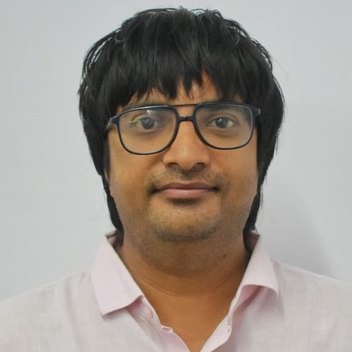
Taught by Darshit Bhatt, founder and lead faculty at Darshit Sir Institute. Instrumentation and Control engineer, with a master's degree and a chartered degree, teaching in Paldi, Ahmedabad since 2006.
Memory hooks
“Mirror adds, lens subtracts”
The two formulas
1/v + 1/u = 1/f for mirrors, 1/v − 1/u = 1/f for lenses. The sign in the middle is the only difference, and it is the one most often written wrong.
“Real is inverted, virtual is erect”
Checking an answer
If your working gives a real image that is upright, or a virtual one that is inverted, a sign has gone wrong somewhere. Use it as a check on every numerical.
“Denser to rarer only”
Total internal reflection
TIR needs light going from denser to rarer and an angle beyond the critical angle. Both conditions, every time, which is how optical fibres and diamonds work.
“Microscope objective small, telescope objective large”
Which focal length goes where
A microscope needs a very short objective focal length; a telescope needs a very long one. Their eyepieces are short in both.
Where marks go
Test yourself
Ask DSI
Tell us the chapter and your class. We will tell you honestly whether our batch helps.
Related
Bring the student's last two report cards. You will get an honest read on where they stand and which batch actually helps, from the person who will do the teaching.
Get in touch
Four different ways, whichever suits you.
Enquiry
Four required fields, the rest optional. We will open WhatsApp with your details written out, ready for you to send.
Almost there
Your browser blocked the automatic hand-off, which is normal inside the Instagram and Facebook apps. Your enquiry is written and ready. Tap below to open WhatsApp and send it.
Open WhatsApp and sendIf it still will not open, save this number and message it directly: +91 98981 73421
Can we count your visit?
We use Google Analytics and Microsoft Clarity to see which pages help and which ones confuse. They set cookies. We do not run adverts and we never share this with anyone. Everything on the site works the same if you say no.